
At Synergy – The Retreat Show 2026, Rajesh Ramani invited us to reconsider the relationship between experience, awareness and inner freedom, challenging some of the assumptions that underpin the way we travel, create retreats and pursue wellbeing.
A guest arrives at a beautiful coastal resort. They put down their bags, walk towards the ocean and stand in awe of the view. They could look at it all day, they think. An hour later, they are taking photographs. The following morning, they request a table overlooking the water. By the afternoon, they are wondering what else there is to see. The ocean hasn't changed, but their relationship with it has.
It was with this familiar observation that Rajesh Ramani opened his session, inviting us to explore what it really means to be free within. In an industry that continually seeks to deliver something new, something special and something different, his reflections raised an important question: are we helping people to experience more, or are we simply giving them more experiences?
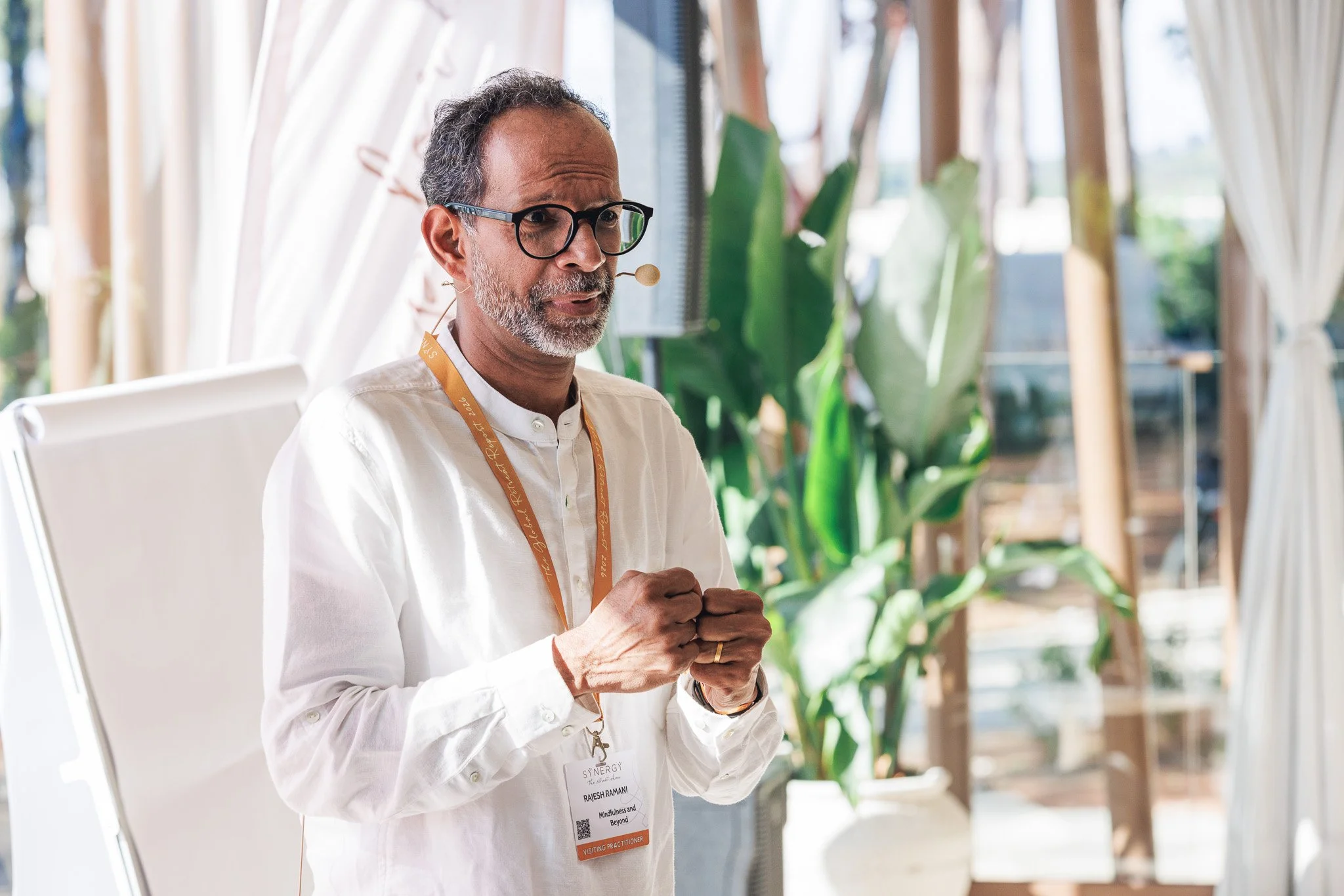
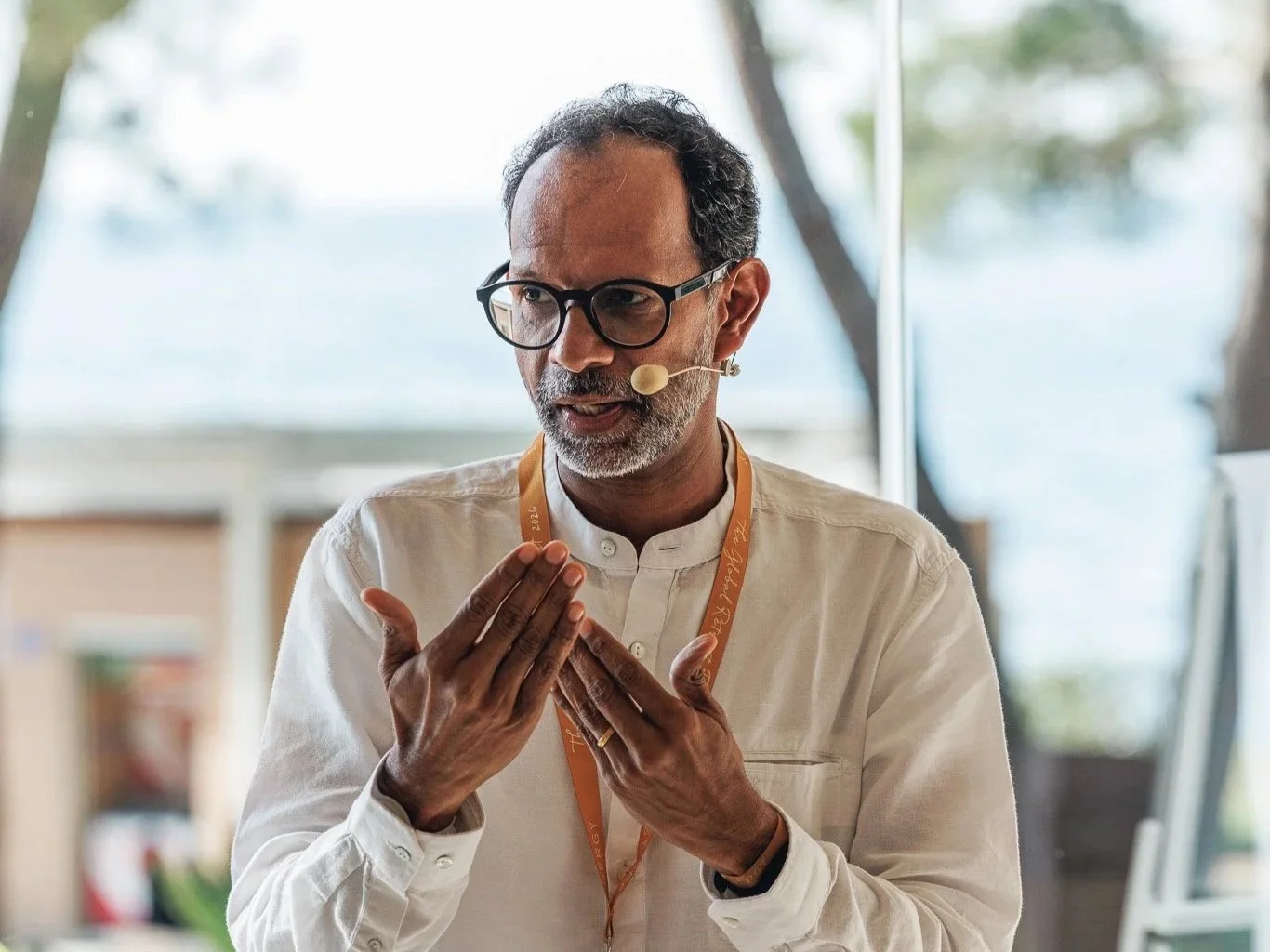
Rajesh Ramani, speaking at Synergy - The Retreat Show, 2026 in Croatia
THE PURSUIT OF MORE
The travel industry thrives on discovery. New destinations, extraordinary encounters and carefully curated experiences inspire people to venture beyond the familiar. Yet there is a point at which the pursuit of novelty can begin to undermine the very experience we are seeking.
“The more you acquire, the lesser you experience,” Rajesh observed. He recalled his first visit to Paris, when, determined to see as much as possible in two days, he rushed between landmarks before heading to the Louvre. Asking a member of staff what the most important thing to see was, he was directed towards the Mona Lisa. Within twenty minutes, he had found it, taken photographs and left.
Years later, his lasting memory was not of the artwork or the extraordinary collections surrounding it, but of the twenty minutes it took to complete the task. It is a pattern that extends into wellness travel. Guests arrive at a retreat and fill their itineraries with treatments, classes, consultations and activities, moving from one experience to the next without allowing themselves the space to absorb any of them. “So this looks like they are adding everything, but at the end of the whole journey they are just simply tired,” he explained. “They are tired of each experience and they don't know what happened to them.”
For retreat creators, this presents an interesting challenge. When guests associate value with the number of experiences included in a programme, how do we communicate the value of spaciousness, simplicity and time spent doing very little? Perhaps a more meaningful measure of a retreat is not how much a guest has experienced, but how fully they have experienced it.
LEARNING TO LET THE BREEZE PASS
Rajesh described two contrasting responses to watching a sunset. One came from a successful businessman who, encouraged to spend time by the ocean, found the experience frustratingly slow. In the time it had taken the sun to set, he could have answered five emails. Others, meanwhile, might find that same sunset unbearably short, wishing they could prolong the moment and hold on to the feeling it created.
Although seemingly opposite responses, both reveal a difficulty in accepting an experience for what it is. One wants the moment to end; the other wants it to last forever. “An optimal experience is when the breeze comes and touches you. You feel it, you know it, and then the breeze is gone and you feel it and you know it.” The question, Rajesh suggested, is whether we can allow ourselves to be touched by something beautiful without needing to possess it. “The conflict within robs us of the quality of our experiences.”
This is particularly relevant to retreat environments, where guests may arrive with expectations of how they should feel, what they should achieve or who they should become. When an experience is approached with an attachment to a particular outcome, there is a risk that what is actually happening becomes secondary to what we believe should be happening.
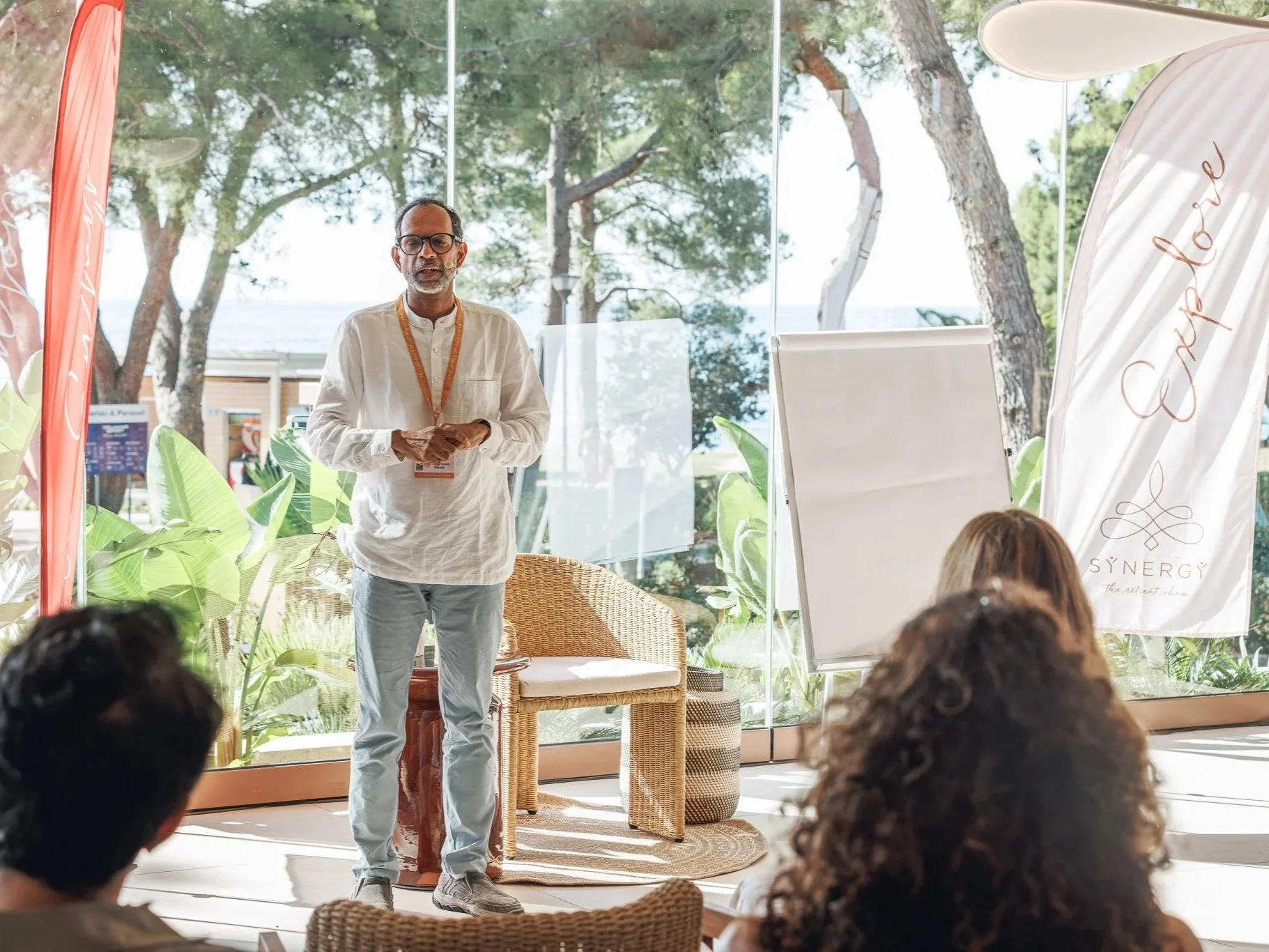
THE INNER WORLD THROUGH WHICH WE EXPERIENCE THE OUTER WORLD
During his session, Rajesh shared a deeply personal moment from his time at Synergy. Whilst attending the opening evening, surrounded by people in a beautiful setting, he received news that his spiritual teacher, whom he had known for more than thirty years, had passed away. “Everything was beautiful around me right then and there, but nothing was beautiful around me right then and there.”
The surroundings had not changed, but his inner world had. It was a poignant illustration of the relationship between our internal state and our external environment. No matter how extraordinary a destination or thoughtfully designed a retreat, the guest experiences it through the lens of their own emotional world.
“Your inner world is as important as the outer world.” For the wellness hospitality industry, this offers a valuable perspective. Beautiful surroundings, exceptional facilities and meaningful practices can create favourable conditions for wellbeing, but they cannot determine how another person will feel. Recognising this allows us to approach retreat design with greater humility. Rather than promising transformation, we can create environments in which transformation has the possibility to occur.
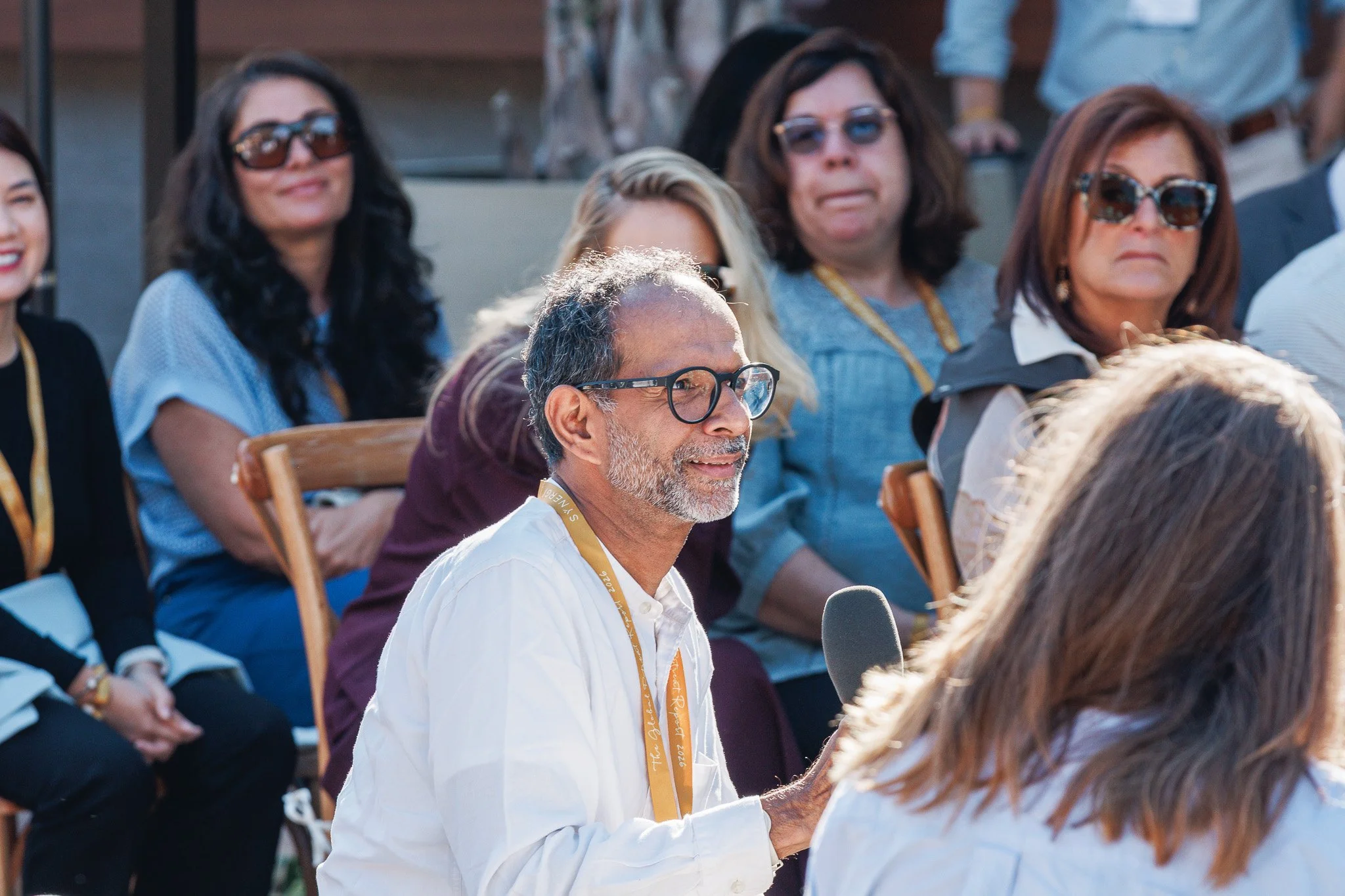
WHAT DOES IT REALLY MEAN TO BE PRESENT?
Few concepts are more familiar within wellness than being present. Yet, as Rajesh pointed out, the phrase has become so widely used that its meaning can easily be lost. Does being present mean focusing on our senses? Does it mean getting out of our heads? Does thinking about the future necessarily mean we are no longer present?
Rajesh challenged these assumptions, reminding us that even a thought about the past or future is occurring in the present moment. What matters is whether we are aware of it. “Being present is to be aware of what is happening right then and there.” That awareness might encompass a thought, a physical sensation, a discomfort or an emotion. It does not require us to achieve a particular state of calm. In fact, trying too hard to be present can become another distraction, another task to accomplish. “Trying to be in the present is not being in the present. Those are two different things.”
There is an important distinction here for an industry increasingly concerned with mindfulness and intentional living. Presence is not necessarily peaceful, aesthetically pleasing or even enjoyable. Sometimes it means acknowledging boredom, sadness, frustration or discomfort without immediately trying to change it.
Rajesh humorously described the imagined perfection of sitting on a tropical beach with a cocktail and a book. The reality, of course, might also include mosquitoes, uncomfortable heat and wet hands making it impossible to turn the pages. Why not include the mosquitoes in the experience of being present, he asked? “The wholesome experience is the one that fulfils us. Not the picture that our mind creates.”
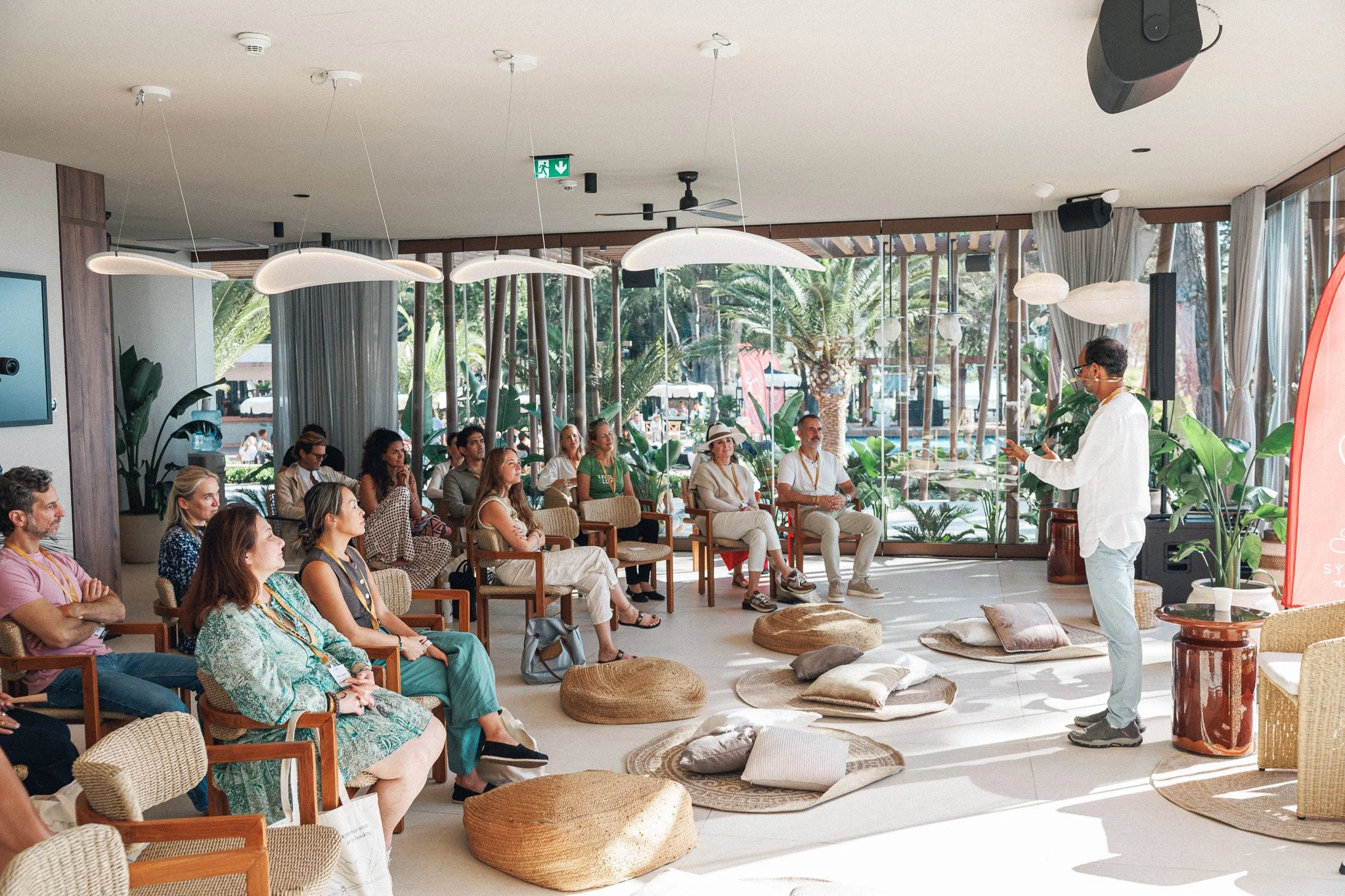
FROM EXCITEMENT TO FULFILMENT
Within travel and hospitality, considerable attention is given to creating memorable moments: the unexpected encounter, the spectacular view, the surprise that makes a guest say “wow”. But whilst excitement has its place, Rajesh invited us to consider what lies beyond it. “Excitement is very temporary. It comes in, it gets bored easily. The mind which is excited gets bored pretty fast. But there is something more than excitement. That is fulfilment.”
Fulfilment, in his understanding, comes from our capacity to remain present as life changes around us, rather than continually seeking the next heightened experience. This distinction may be particularly valuable for retreat leaders considering the lasting impact of their programmes. An extraordinary experience can create a powerful memory, but developing the capacity to engage more fully with ordinary life offers a different kind of value.
What happens when the guest returns home, when the beautiful surroundings, attentive service and daily practices are no longer immediately available? Can the retreat help them cultivate something they are able to carry into the less extraordinary moments of everyday life?
EXPANDING OUR CAPACITY TO HOLD LIFE
Travel is often celebrated for its ability to broaden perspectives, introduce us to different cultures and challenge our assumptions. Rajesh encouraged us to consider whether we approach our internal world with the same spirit of exploration. “External world supports you, but internally, how much do you push your boundaries?”
He described our internal boundaries as a circle. Within it are the people, behaviours and experiences we are comfortable with. Beyond it are the things we resist, judge or struggle to accept. Inner freedom, he suggested, comes from expanding that circle. He illustrated this through our tendency to judge in others the very qualities we recognise in ourselves: laziness, dishonesty, insecurity and the desire to impress.
Drawing on his own background as a monk, Rajesh admitted to feeling uncomfortable around people who appeared ostentatious, only to recognise that his eagerness to share his philosophical knowledge was not so different from someone displaying an expensive handbag. “My insecurity is not different from your insecurity. We just have it in different areas.” Recognising our shared humanity can soften the divisions we create between ourselves and others.
This does not mean abandoning personal boundaries, tolerating harmful behaviour or agreeing with everyone. Rather, it invites us to examine the internal resistance that can prevent us from seeing the person behind their behaviour. “Peace is not the absence of things that you don't like or absence of noise. Peace is the absence of conflict with whatever is there.”
THE SPACE WE HOLD FOR OTHERS
For those working in hospitality, retreats and wellness, Rajesh's reflections have implications that extend beyond personal development. He spoke about the familiar practice of labelling guests as difficult before they have even arrived. Once that label has been established, every interaction risks being interpreted through it. Yet, when he met some of these supposedly difficult guests, he often encountered ordinary people dealing with the difficulties of their own lives. “You don't have to transform them. You don't have to be best friends with them. You don't have to embrace them. But can you hold a space?”
The quality of hospitality, then, is not simply determined by the service we provide, but also by the attitude with which we provide it. A guest may forget the finer details of their itinerary, yet remember an encounter in which they felt genuinely listened to, understood or accepted. Rajesh described the comfort of being able to be oneself as one of the most meaningful things we can offer another person. When we create an environment in which people feel less need to defend themselves or conceal their imperfections, we offer something that cannot be manufactured through facilities or programming alone. It is a reminder that the inner work of the people delivering wellness experiences is as relevant as the experiences themselves.
BEING FREE WITHIN
Rajesh concluded his session with a guided meditation, encouraging participants to notice their own internal boundaries, recognise the people and qualities they resist, and explore what it might feel like to soften that resistance. Through the simple rhythm of breathing in and breathing out, participants were invited to acknowledge each moment as it arrived and allow it to pass. “To be free within is to create a space of least resistance. Create a space of expansion and create a space of allowing things to touch you and letting go of things.”
The session closed with an invitation to look around at the surrounding landscape and consider what we would remove to make it perfect. The glass separating us from the ocean? The mosquitoes? Something else? Once we begin looking for imperfections, there is no natural end to the process. The mind can always find another detail to change.
Perhaps, instead, there is something to be gained from experiencing the whole picture. For an industry devoted to enhancing the human experience, Rajesh's session offered a quietly powerful reminder: the most meaningful experiences may not come from adding more to our lives, but from expanding our capacity to be with life as it is. “What is real is in front of you in the moment.”
B. Joseph Pine II delivered his session, 'How Retreats Can Create Lasting Change', at the fifth edition of Synergy – The Retreat Show in Istria, Croatia, in 2026. An internationally acclaimed Author, Speaker and Management Advisor, his work explores the evolution of economic value through experiences and transformations.